

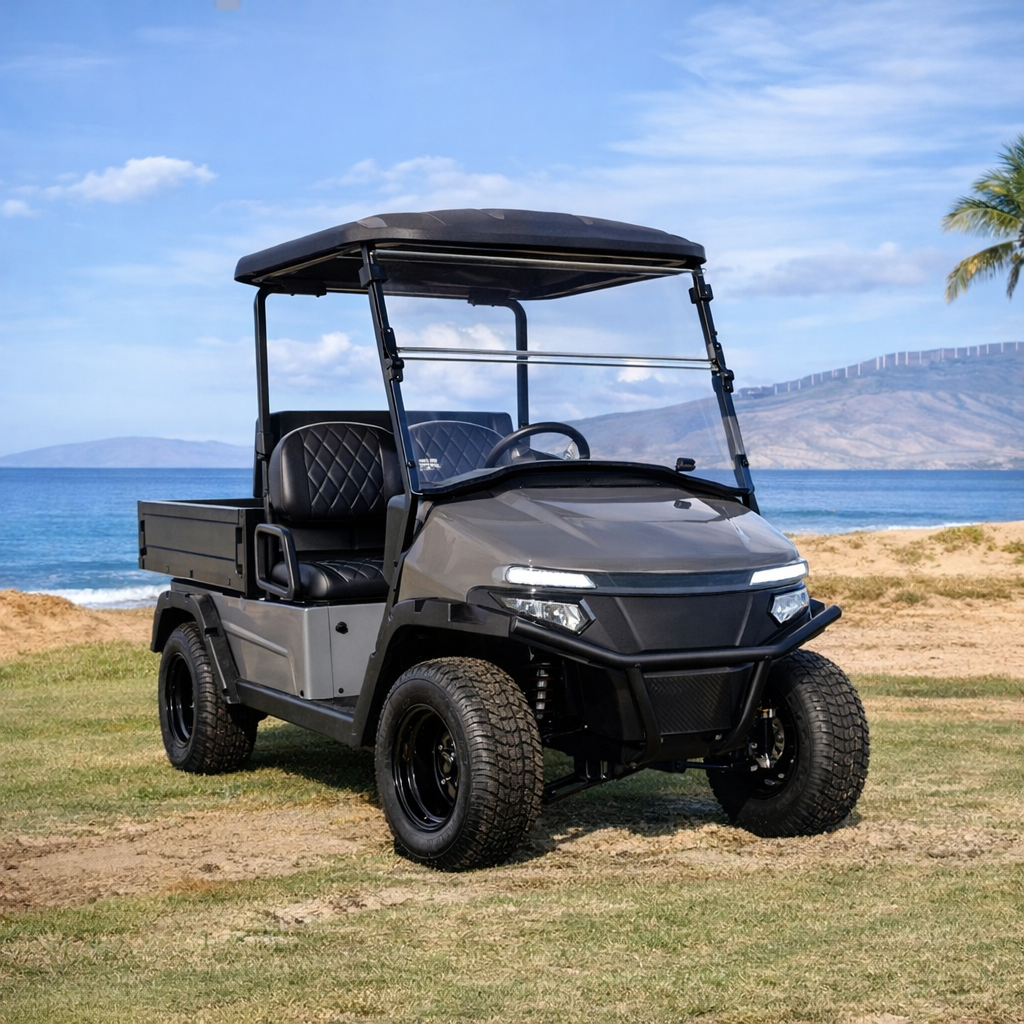
Across Hawaii’s neighborhoods, resort communities, and planned subdivisions, a quiet shift in local transportation has been taking place. More homeowners are choosing street-legal electric golf carts as their primary vehicle for daily local travel. This is not a trend driven by novelty. It reflects practical decisions about cost, convenience, and the reality of how most people actually get around on the islands.
The Primary Reasons Hawaii Homeowners Are Making the Switch
The Real Cost of Driving a Car in Hawaii
Vehicle ownership in Hawaii is genuinely more expensive than in most other states. Cars must be shipped to the islands, which adds several thousand dollars to the base price of any new or used vehicle. Gasoline prices in Hawaii are consistently among the highest in the country. Insurance costs are above the national average.
Hawaii’s Geography Suits Short-Distance Travel
The geographic reality of daily life for most Hawaii homeowners is that a large percentage of trips are short. Running to a nearby market, visiting a neighbor, going to the beach, attending a community event, or getting to a local restaurant typically involves distances that are well within the range of a fully charged electric golf cart.
Parking Is Genuinely Easier
Parking frustration is a real part of daily life in Hawaii’s more populated and tourist-heavy areas. Beach parking lots, shopping center spaces, and restaurant areas fill up quickly during peak hours and tourist season. A smaller vehicle with a tighter footprint is easier to park in more places, and in some informal settings, golf carts can be positioned in spots where a full-size car simply would not fit.
The Environmental Dimension
Hawaii has set ambitious goals for transitioning to clean energy and reducing carbon emissions. Many residents share those values and look for practical ways to align their daily choices with them. Electric golf carts produce zero direct emissions during operation. They run on electricity that, in Hawaii’s case, is increasingly being generated from renewable sources. For homeowners who have also invested in solar panels, the ability to charge a golf cart from their own generated electricity represents a complete loop from a sustainability standpoint.
Understanding Street-Legal Golf Cart Requirements at a Glance
Before purchasing, it helps to understand exactly what distinguishes a street-legal golf cart from a standard model. The table below outlines the key differences. For a detailed look at available models, the 808 Golf Carts inventory provides a current overview of what is available in Hawaii.
| Feature | Standard Golf Cart | Street-Legal Golf Cart (LSV) |
| Speed capability | Up to 15 mph | Up to 25 mph (federally defined LSV limit) |
| Headlights | Optional or basic | Required; must meet safety standards |
| Tail and brake lights | Often basic or absent | Required by law for road use |
| Turn signals | Not standard | Required for street-legal classification |
| Mirrors | Not required | Rearview and side mirrors required |
| Seat belts | Not standard | Required for all seating positions |
| Horn | Sometimes included | Required |
| VIN and registration | Not applicable | Required for public road use in Hawaii |
| Insurance | Not required off-road | Required for street use |
| Seating options | 2 to 6 seats typical | 2 to 8 seats; 8-seat models available |
The Growing Appeal of 8-Seat Golf Carts for Hawaii Homeowners
One of the more notable trends in the Hawaii golf cart market is the increasing demand for larger configurations. The 8 seater electric golf cart has become particularly relevant for homeowners with larger families, those who regularly host guests, and multi-generational households where moving a full group of people in a single vehicle is a genuine practical need.
Why an 8-Seat Configuration Makes Sense in Hawaii
Hawaii’s culture places a strong emphasis on family and community. Households that include grandparents, adult children, and multiple younger family members are common. Resort communities and vacation properties often host groups of eight or more. In both contexts, the ability to transport everyone together in a single trip, without needing to coordinate two vehicles, simplifies logistics and reduces cost.
Practical Uses for an 8-Seat Golf Cart in Hawaii
- Transporting an extended family group to a beach, park, or community event in a single vehicle
- Moving vacation guests between a property and nearby attractions within a resort area
- Shuttling children and adults between homes in a planned community
- Providing transportation at private events, family gatherings, or group celebrations
- Covering the kind of short, repeated local trips where running two cars would be inefficient; learn more about available options at the 808 Golf Carts 8-seater page
What to Consider Before Making the Switch
Switching to a street-legal golf cart as your primary or secondary vehicle is a practical decision that benefits from careful preparation. Here are the key considerations worth working through before purchasing. If you have questions specific to Maui, the 808 Golf Carts Maui services page covers local service and support options.
Map Your Regular Routes
Start by identifying where you actually travel on a daily and weekly basis. List your most common destinations and estimate the distances involved. Then confirm whether those routes involve roads with speed limits of 35 mph or lower, which is the threshold for street-legal golf cart use in Hawaii. If the majority of your regular travel falls within those parameters, a golf cart will cover most of your needs.
Assess Your Household Size and Seating Needs
The right seating configuration depends entirely on your household. A couple or individual may find a two or four-seat model completely adequate. A family with children, or a household that regularly transports guests, will want at least four seats and should consider whether a six or eight-seat model fits the way they actually use a vehicle. Reviewing the full range at the 808 Golf Carts inventory helps you identify which configuration matches your situation.
Final Thoughts
The shift toward street-legal electric golf carts among Hawaii homeowners is grounded in practical reality. High vehicle costs, expensive fuel, short daily trip distances, parking challenges, and a cultural emphasis on sustainability all point in the same direction. For many residents, a golf cart is not a luxury or a novelty. It is the most sensible transportation option for the way they actually live.
Larger configurations, including the 8 seater electric golf cart, have expanded the appeal to households that need more capacity than a standard two or four-seat model provides. Whether for a multi-generational family, a vacation property hosting groups, or a community with shared transportation needs, the eight-seat option addresses a real and specific gap.
Frequently Asked Questions
Are street-legal golf carts allowed on all roads in Hawaii?
No. Street-legal golf carts, classified as Low-Speed Vehicles, are permitted on public roads with posted speed limits of 35 mph or lower. They are not allowed on highways or roads with higher speed limits.
What does it take to register a golf cart as street-legal in Hawaii?
To register a golf cart as a street-legal Low-Speed Vehicle in Hawaii, the vehicle must meet federal LSV safety standards, including headlights, tail lights, brake lights, turn signals, mirrors, seat belts, horn, and windshield.
How many people can an 8-seat golf cart carry?
An 8 seater electric golf cart is configured to carry eight passengers. Seating arrangements vary by model, with some featuring forward-facing bench seating and others offering a combination of facing configurations.
How long does it take to charge an electric golf cart?
Charging time varies by battery size and charger type. Most standard electric golf carts charge fully in six to eight hours using a standard 110V household outlet. Some models with larger battery packs may benefit from a 220V charger to reduce charging time.
Is an 8-seat golf cart available for purchase in Hawaii?
Yes. An 8 seater golf cart for sale in Hawaii is available through local dealers who specialize in electric golf carts. Purchasing locally rather than through an out-of-state or online retailer has the advantage of local service, support, and the ability to see the vehicle in person before buying.
How do I find out which golf cart model is right for my household?
The best starting point is reviewing the available inventory and then speaking directly with a dealer who understands the local Hawaii market and can advise based on your specific situation. The 808 Golf Carts contact page is available for this kind of inquiry, and the team can walk you through the options based on your household size, typical routes, and budget.