
If you are considering purchasing a golf cart for use on public roads in Hawaii, one of the first practical questions is what it will actually cost. The answer involves more than the sticker price on the vehicle. Making a golf cart street-legal in Hawaii carries its own requirements, and the total cost of ownership includes registration, insurance, ongoing maintenance, and energy costs alongside the purchase price.
This guide walks through the full cost picture for street-legal golf carts in Hawaii, from entry-level two-seat models to larger configurations including the 8 seater electric golf cart. It covers new versus used pricing, what drives the variation in price, and the ongoing costs buyers should plan for. Price ranges included here are general estimates and will vary by model, condition, and market availability. Speaking with local golf cart dealers directly will give you the most accurate current pricing for your specific needs.
Understanding What Street-Legal Means in Hawaii
Before looking at costs, it is important to understand what the street-legal designation actually requires, because it directly affects what you pay and what you need to budget for beyond the vehicle itself.
The Low-Speed Vehicle Standard
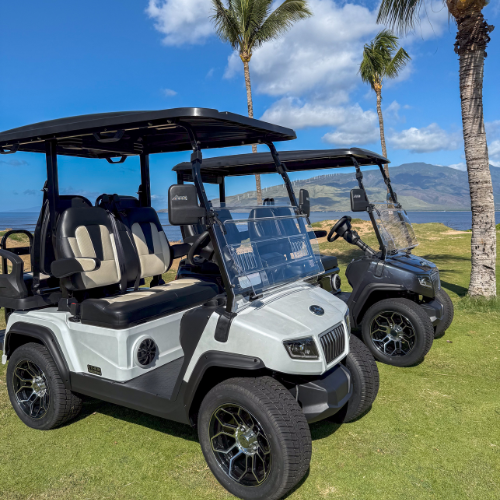
In Hawaii, golf carts used on public roads must meet the federal Low-Speed Vehicle (LSV) standard. This classification applies to four-wheeled electric vehicles capable of reaching speeds between 20 and 25 miles per hour. LSVs must be equipped with a defined set of safety features: headlights, tail lights, brake lights, turn signals, mirrors, seat belts, a horn, and a windshield.
Not all golf carts sold on the market come configured to meet these requirements. Some are designed purely for private property or golf course use and lack the required safety equipment. If a golf cart does not already meet LSV standards, it can sometimes be upgraded with an aftermarket street-legal kit, but this adds to the total cost and must be professionally installed to be effective.
Registration, Insurance, and Road Access
A street-legal golf cart in Hawaii must be registered with the state, carry a valid vehicle identification number, and be covered by liability insurance. These are recurring costs, not one-time expenses. Registration and insurance add to the annual cost of ownership and should be factored into any realistic budget from the start.
Street-legal golf carts in Hawaii are permitted on public roads with posted speed limits of 35 mph or lower. They are not allowed on highways. This road access limitation is not a cost factor, but it shapes how and where the vehicle is useful, which informs which configuration and price tier makes the most sense for your situation.
Purchase Price Ranges: What to Expect by Configuration
Golf cart prices in Hawaii vary based on seating capacity, whether the vehicle is new or used, its condition, the brand, and whether it is already configured to meet street-legal requirements. Browsing the 808 Golf Carts inventory gives you a current view of what is available locally and at what price points.
Two-Seat Models
A standard two-seat electric golf cart is the most affordable entry point. New two-seat models from established manufacturers typically fall in the range of approximately 5,000 to 9,000 dollars, depending on features, battery type, and whether the model is configured for street-legal use. Used two-seat carts in good condition can be found for considerably less, though battery health is the most important variable to assess before purchasing a used model.
For individuals or couples who primarily want a golf cart for short local errands within a community, this configuration is often sufficient and represents the lowest cost of entry into the street-legal category.
Four-Seat Models
The four-seat electric golf cart is the most popular configuration for families and small households. New four-seat models with LSV-compliant equipment typically range from approximately 9,000 to 14,000 dollars. This price range reflects the additional seating, larger frame, and enhanced safety equipment required for road use.
Used four-seat carts are widely available and can represent good value. Prices for used four-seat models in reasonable condition generally fall between 4,500 and 9,000 dollars, with the variation driven primarily by age, brand, battery condition, and whether the vehicle is already street-legal compliant.
Six-Seat Models
Six-seat configurations offer a middle ground for households that regularly transport more than four people but do not need the full capacity of an eight-seat model. New six-seat electric golf carts configured for street-legal use typically range from around 12,000 to 18,000 dollars. These models are popular for larger families, small vacation rental properties, and buyers who want additional passenger flexibility without the full cost of an eight-seat model.
Eight-Seat Models
The 8 seater electric golf cart sits at the higher end of the golf cart price range. New eight-seat models configured to meet street-legal requirements typically cost between approximately 15,000 and 22,000 dollars or more, depending on the brand, features, battery capacity, and specific configuration.
Used eight-seat models are available at lower price points, generally in the range of 9,000 to 15,000 dollars for vehicles in good condition. As with any used golf cart, battery health is a critical factor. An 8 seater golf cart for sale in Hawaii through a local dealer with a service history provides more confidence in the vehicle’s condition than a private sale where the maintenance record is unclear.
The eight-seat configuration is particularly well-suited for large families, multi-generational households, vacation rental properties that host large groups, and buyers who regularly need to transport eight people together on local trips. While the purchase price is higher than smaller models, it is still substantially lower than a van or large SUV with equivalent passenger capacity.
What Drives Price Variation Between Models
Understanding why golf cart prices vary helps buyers make more informed comparisons when evaluating their options. Several factors consistently affect the price of both new and used models.
Battery Type and Capacity
Battery technology is one of the most significant cost drivers in electric golf carts. Lithium-ion battery packs are more expensive than traditional lead-acid batteries but offer longer range, faster charging, longer lifespan, and less maintenance. A golf cart with a lithium battery will typically cost more upfront but may have a lower total cost of ownership over several years due to reduced replacement and maintenance needs.
For buyers considering a used golf cart, battery condition is the most critical factor to evaluate. A cart with a depleted or failing battery may require a battery replacement costing anywhere from 800 to 2,500 dollars or more depending on battery type and capacity, which should be factored into the effective purchase price.
Brand and Build Quality
Established golf cart manufacturers with strong reputations for reliability and parts availability typically command higher prices than lesser-known brands. Paying more for a reputable brand often means better build quality, more accessible parts if repairs are needed, and a more predictable ownership experience. In Hawaii, where parts may need to be ordered from the mainland, a brand with reliable supply chains matters more than it might in other markets.
Street-Legal Equipment and Compliance Status
A golf cart that is already fully configured to meet Low-Speed Vehicle standards costs more than a basic model that requires upgrades to reach compliance. When comparing prices between models, confirm whether the asking price includes all required street-legal equipment or whether additional investment is needed to make the vehicle road-ready.
New Versus Used Condition
The age and overall condition of a used golf cart affects price significantly. A well-maintained two-year-old cart from a reputable dealer with a service history is worth considerably more than an older model with unknown maintenance history and worn components. Purchasing from an established local dealer rather than a private seller provides more confidence in the vehicle’s actual condition and reduces the risk of unexpected post-purchase costs.
Ongoing Costs Beyond the Purchase Price
The total cost of owning a street-legal golf cart in Hawaii extends beyond the initial purchase. Planning for these ongoing costs gives buyers a realistic picture of what ownership actually involves. For service and maintenance in Hawaii, local providers such as 808 Golf Carts on Maui can advise on what to expect for specific models.
Registration and Licensing
Street-legal golf carts registered as Low-Speed Vehicles in Hawaii are subject to the same annual registration process as standard motor vehicles. Registration fees vary by county but are generally modest. Budget for this as a recurring annual cost from the time of purchase.
Insurance
Liability insurance is required for street-legal golf carts operated on public roads in Hawaii. Golf cart insurance is generally less expensive than standard vehicle insurance given the lower speeds and values involved, but the specific cost depends on the insurer, the coverage level, and whether the cart is used for personal or commercial purposes such as a vacation rental amenity.
Charging and Energy
One of the genuine advantages of an electric golf cart is the low cost of energy. A full charge from a standard household outlet costs a small amount in electricity, far less than the equivalent distance in a gasoline vehicle at Hawaii’s elevated fuel prices. For most residential users, the annual energy cost for a golf cart is minimal.
Maintenance and Servicing
Electric golf carts have fewer maintenance requirements than internal combustion vehicles. There is no engine oil, exhaust system, or complex transmission to service. The primary maintenance items are the battery system, tires, brakes, and general inspection. Annual maintenance costs for a well-maintained electric golf cart are typically modest, though a battery replacement when needed represents the largest single maintenance expense over the cart’s lifespan.
- Tire replacement: every two to four years depending on use; cost varies by size and brand
- Brake service: periodic inspection and replacement as needed; lower frequency than for cars
- Battery maintenance: periodic fluid checks for lead-acid batteries; monitoring for lithium models
- Battery replacement: typically every four to seven years for lead-acid; longer for lithium
- General cleaning and minor repairs: minimal but recurring cost throughout ownership
New vs. Used: Which Makes More Sense in Hawaii?
The decision between a new and used golf cart comes down to budget, risk tolerance, and how important reliability is for your intended use.
The Case for Buying New
A new golf cart comes with a manufacturer warranty, known condition, and the latest battery technology. For buyers who need confidence in reliability, particularly for vacation rental use where a breakdown during a guest stay creates problems, the additional cost of a new model may be worthwhile. Working with local golf cart dealers to purchase new also establishes a service relationship that continues after the sale.
The Case for Buying Used
A well-maintained used golf cart from a reputable source can represent strong value, particularly for buyers with a clear budget constraint. The key is assessing battery condition carefully and confirming that the vehicle meets or can be brought up to street-legal requirements. Reviewing available used inventory through established local dealers is preferable to private purchases where the full maintenance history may not be known.
Final Thoughts
The cost of a street-legal golf cart in Hawaii spans a wide range depending on configuration, age, condition, and whether the vehicle already meets Low-Speed Vehicle requirements. Entry-level two-seat models represent the most affordable starting point, while eight-seat configurations designed for larger groups sit at the higher end of the range but still offer meaningful cost advantages over full-size vehicle alternatives with equivalent capacity.
Beyond the purchase price, buyers should plan for registration, insurance, energy costs, and periodic maintenance as part of the full ownership picture. These ongoing costs are generally modest for electric golf carts compared to standard cars in Hawaii, where fuel and vehicle expenses are elevated by the island’s logistics.
For anyone researching options, starting with a review of the 808 Golf Carts inventory gives a current picture of what is available locally. Speaking directly with local golf cart dealers provides pricing specific to current market conditions and helps match the right model to your situation, whether that is a compact two-seat model for daily local use or a fully equipped 8 seater electric golf cart for a large household or vacation property.
Frequently Asked Questions
What is the average cost of a street-legal golf cart in Hawaii?
The price depends heavily on seating configuration and whether the cart is new or used. A new four-seat street-legal model typically falls between 9,000 and 14,000 dollars. A new eight-seat model generally ranges from 15,000 to 22,000 dollars or more. Used models at equivalent configurations are available at lower price points, with condition and battery health being the key variables that affect value.
Are 8-seat golf carts available for purchase in Hawaii?
Yes. An 8 seater golf cart for sale in Hawaii is available through local dealers who carry new and sometimes used inventory. Purchasing locally allows buyers to inspect the vehicle, confirm street-legal compliance, and access ongoing service support after purchase.
What is the difference in cost between a standard and street-legal golf cart?
A street-legal golf cart configured as a Low-Speed Vehicle includes additional safety equipment, including headlights, tail lights, brake lights, turn signals, mirrors, seat belts, a horn, and a windshield. This equipment adds to the purchase price compared to a basic off-road or golf course model. If a standard cart needs to be upgraded to meet street-legal requirements, an aftermarket kit typically adds 800 to 2,500 dollars to the total cost.
Is it cheaper to buy a golf cart in Hawaii or ship one from the mainland?
Shipping a golf cart from the mainland to Hawaii involves freight costs that can add several hundred to over a thousand dollars to the purchase price, plus the logistical complexity of coordinating delivery and potentially waiting for the vehicle to arrive. Purchasing from a local dealer avoids these costs and provides the advantage of inspecting the cart in person and having a local service relationship.
What ongoing costs should I plan for when owning a golf cart in Hawaii?
The main ongoing costs are annual registration, liability insurance, electricity for charging, and periodic maintenance including tires, brakes, and battery service. For most owners, the total annual ongoing cost is modest compared to operating a standard car in Hawaii, where gasoline prices and vehicle maintenance costs are consistently above the national average.
How do I find a reputable golf cart dealer in Hawaii?
Working with established local golf cart dealers in Hawaii provides advantages over purchasing from general online marketplaces or mainland sellers. A local dealer can help confirm street-legal compliance, provide service after purchase, and advise on which model suits your specific situation. The 808 Golf Carts contact page is available for inquiries about current inventory and pricing.