


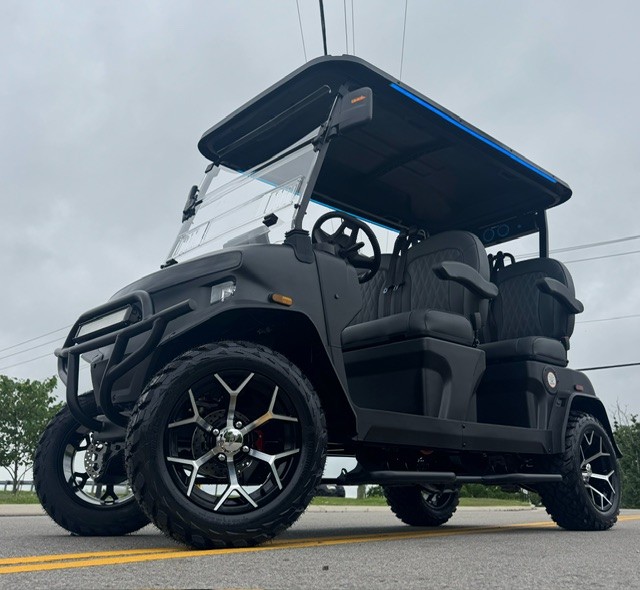
Knowing exactly which golf cart you own is more important than it may seem.
Two carts can look almost identical but use different batteries, controllers, suspension components, wiring systems or replacement parts. Even carts from the same manufacturer can change significantly between model years.
That is why the golf cart serial number is one of the most useful pieces of information an owner can have.
Depending on the vehicle, you may also find a VIN, PIN, manufacturer code or model number. These identifiers can help determine the cart’s make, model year, production information and correct parts.
For owners buying replacement components, researching a used cart or trying to understand an unfamiliar vehicle, this guide explains where to start.
Golf Cart Serial Number vs. VIN: What Is the Difference?
A serial number and VIN are not always the same thing.
Traditional golf carts are not necessarily manufactured as road-going motor vehicles. Many therefore use manufacturer-specific serial numbers instead of the standard 17-character VIN found on passenger cars.
A golf cart serial number is assigned by the manufacturer and is primarily used to identify the individual vehicle and its production details.
A VIN, or Vehicle Identification Number, follows a standardized 17-character format for motor vehicles subject to VIN requirements.
The National Highway Traffic Safety Administration explains that a standard VIN contains 17 characters and encodes information about a particular motor vehicle. NHTSA also provides an official public VIN decoder.
This distinction is particularly relevant for street-legal golf cars and low-speed vehicles.
For example, Club Car confirms that its Low Speed Vehicles have VIN numbers, while its non-LSV vehicles use serial numbers instead.
Why Is the Golf Cart Serial Number Important?
Your cart’s identification number can help with much more than determining its age.
Owners may need it when:
Ordering replacement parts
Checking the model year
Buying accessories
Requesting service
Finding an owner’s manual
Researching recalls
Verifying a used cart
Checking warranty information
Confirming registration details
Selling the vehicle
Different production years can use different components even when the exterior styling appears similar.
For this reason, parts suppliers and service technicians may ask for the serial number before recommending a component.
Where Can You Find a Golf Cart Serial Number?
There is no universal location.
Manufacturers place identification labels in different areas, and the position may even vary between models from the same brand.
Common places to inspect include:
Under the dashboard
Below or near the cup holders
Under the driver’s seat
Under the passenger seat
On the steering column
On the vehicle frame
Inside the glove compartment
Near the accelerator or brake pedal
On the chassis crossmember
Look for a barcode label, metal plate or printed manufacturer sticker containing letters and numbers.
If you cannot find the label immediately, do not assume it has been removed. Check the owner’s manual for the exact model or inspect the frame carefully.
How to Read a Club Car Serial Number?
Club Car provides one of the clearest examples of how manufacturer serial numbers can contain model and production information.
According to Club Car, its serial number label is typically located either below the passenger-side cup holder or above the accelerator or brake pedal.
A serial number may look similar to:
PH0901-123456
In Club Car’s system:
PH identifies the vehicle model.
09 identifies the model year.
01 identifies the production week.
123456 is the unique sequential number assigned to that vehicle.
Club Car therefore allows owners to use both the prefix and production digits to help identify the model and year.
The manufacturer also maintains a serial-prefix directory for identifying vehicle models.
This example is useful because it shows why entering a number into a generic golf cart VIN decoder may not always work. A manufacturer serial number may follow a completely different structure from a standardized VIN.
How to Find an E-Z-GO Serial Number?
E-Z-GO serial-number locations also vary according to the model and year.
The manufacturer’s current customer information states that vehicles purchased before 2023 may have the serial number next to a barcode on the steering column or below the driver’s-side seat, depending on the model.
Some E-Z-GO owner’s manuals show several identification labels.
For example, certain vehicles have serial and manufacturing information:
On the lower dash area
On the frame
Near the driver’s seat
On rear frame rails
These differences are why it is important to identify the specific model instead of relying on a single universal location.
E-Z-GO documentation also notes that the serial number, manufacture date and model information may be required when ordering the correct service components.
What About Yamaha and Other Golf Cart Brands?
Other manufacturers use their own identification systems.
The label may be found:
Under the seat
On the frame
Near the dashboard
Inside a storage area
On a manufacturer identification plate
Rather than assuming the coding method from another brand applies, use the owner’s manual or manufacturer documentation for the specific vehicle.
This is particularly important for older carts.
Serial formats may change over time, and an online chart created for one generation may not correctly identify another.
If you are purchasing a used vehicle and cannot identify the year confidently, record the complete number and photograph the manufacturer’s label before ordering parts.
Does Every Golf Cart Have a VIN Number?
No.
This is one of the most common sources of confusion when owners perform a VIN lookup.
Traditional golf carts may have only a serial number or manufacturer identification number.
Street-legal LSVs are different.
Because an LSV is designed and certified as a motor vehicle for public-road use, it generally uses a standardized VIN.
Club Car, for example, explicitly distinguishes between its LSVs, which have VINs, and non-LSV carts, which use manufacturer serial numbers.
808 Golf Carts currently focuses on street-legal golf cars and LSVs for Hawaii buyers, so vehicle identification and correct paperwork are particularly important when purchasing a cart intended for public-road use.
How Does a 17-Digit VIN Work?
A standard VIN contains 17 characters.
Although the exact decoding process can become technical, the VIN generally contains information associated with:
Manufacturer
Vehicle attributes
Model information
Production sequence
Model year
Manufacturing location
The characters do not work exactly like a simple sentence where each position always means the same thing across every vehicle type.
Manufacturers submit vehicle information associated with their VIN structure.
For a reliable VIN lookup, the NHTSA VIN Decoder is a useful starting point because its data comes from information reported by manufacturers.
A lookup may return details such as manufacturer, model year and manufacturing plant where sufficient information is available.
Golf Cart VIN Decoder vs. Serial Number Decoder
Understanding which identifier you have prevents wasted time.
| Identifier | Typical Format | Common Use |
|---|---|---|
| Manufacturer serial number | Brand-specific | Model, production year, service and parts |
| VIN | 17 characters | Road vehicle identification and registration |
| PIN | Manufacturer-specific | Vehicle identification on certain models |
| Model number | Manufacturer-specific | Identifying product series or configuration |
| Date code | Manufacturer-specific | Production timing |
If your number does not contain 17 characters, it is probably not a standard VIN.
That does not mean the identifier is incorrect.
It may simply be the manufacturer’s serial-number system.
How to Perform a Golf Cart VIN Lookup?
If your cart has a 17-character VIN, start by copying the number carefully.
VINs may be located on:
A manufacturer plate
The dashboard area
The frame
Registration paperwork
The title or certificate of origin
Vehicle compliance labels
Once you have the full number, enter it into a recognized VIN decoder.
NHTSA’s official decoder can identify information reported by the manufacturer for vehicles in its database.
Check that the decoded details match the actual vehicle.
If a lookup indicates a different manufacturer, model year or vehicle type, verify the number before proceeding.
A single incorrectly copied character can change the results.
How to Identify a Golf Cart’s Model Year?
The method depends entirely on the manufacturer.
For some brands, the year appears within the serial code.
For others, owners must compare the serial or date code with a manufacturer chart.
Club Car offers a good example.
Its serial number uses the four digits following the model prefix to identify the model year and production week.
Do not automatically assume a similar pattern applies to E-Z-GO, Yamaha, Evolution, Denago or another brand.
Use brand-specific documentation.
This is particularly important when buying an older cart advertised by year. Exterior body kits and accessories can make an older chassis look much newer than it actually is.
Why Serial Numbers Matter When Buying a Used Golf Cart?
Used-cart buyers should always inspect the identification label.
It can help verify that the seller’s description matches the vehicle.
Before buying, record:
Manufacturer
Serial number
VIN, if present
Model number
Manufacture date or date code
Battery information
Any registration or title information
Then compare these details with the physical cart.
Buyers should also inspect the mechanical and electrical condition rather than relying solely on age.
The used golf cart pricing guide explains how age, battery condition, equipment and overall condition can influence used-cart value.
A newer model with poor batteries or neglected components may be less attractive than an older cart that has been properly maintained.
Check the Identification Number Before Ordering Parts
One of the most practical uses of a golf cart serial number is parts identification.
Golf-cart manufacturers update components over time.
Two vehicles with nearly identical bodywork may use different:
Controllers
Solenoids
Chargers
Suspension parts
Brake components
Electrical connectors
Steering components
Battery configurations
Ordering by appearance alone can result in the wrong component.
Record the complete serial number before contacting a parts supplier or service technician.
808 Golf Carts provides both sales and parts/service support from its Maui location, and owners who are uncertain about vehicle information can use the contact and service page to provide relevant details before arranging assistance.
What If the Serial Number Label Is Missing?
Older carts sometimes have faded, damaged or missing labels.
Do not immediately guess the year based on the body style.
Body panels, seats, wheels and roofs are easy to replace.
Instead, check for secondary identification marks.
Depending on the manufacturer and model, there may be:
Another serial label
A frame stamping
A PIN
A manufacturing plate
A date code
Original paperwork
Registration records
Owner’s manuals
If identification remains uncertain, provide photographs and any visible codes to a dealer or experienced technician.
Avoid ordering expensive model-specific parts until the cart has been identified confidently.
What If the VIN Does Not Decode?
A failed lookup does not automatically mean the cart is illegitimate.
First check whether you actually have a VIN.
A manufacturer serial number entered into a standard VIN decoder will not work.
If the number contains 17 characters but still does not decode:
Check for typing errors.
Confirm confusing characters carefully.
Compare the number with the physical label.
Check the title or manufacturer paperwork.
Contact the manufacturer or dealer.
NHTSA notes that VIN-decoder information is based on data supplied by manufacturers, and additional information may sometimes be available on the vehicle label itself.
Serial Numbers and Street-Legal Golf Carts in Hawaii
Identification becomes particularly important when a cart will be used as a street-legal vehicle.
Road-going LSVs involve different paperwork and equipment considerations from carts used only on private property.
The 808 Golf Carts Hawaii golf cart buyer’s guide recommends checking vehicle documentation and road-use requirements as part of the purchase process.
Before purchasing a used street-legal vehicle, make sure the identification information matches the paperwork provided.
Do not rely only on accessories such as lights, mirrors or seat belts as evidence that a cart is properly documented for road use.
Golf Cart Identification Checklist
When trying to identify an unfamiliar golf cart, follow this order:
1. Find the manufacturer label.
Look under the dash, seat, steering column and frame.
2. Record every number exactly.
Take a clear photograph as well.
3. Determine whether it is a serial number or VIN.
A standard VIN contains 17 characters.
4. Identify the manufacturer.
Use the logo, label or documentation.
5. Use manufacturer-specific information.
Do not use a Club Car decoding pattern for another brand.
6. Verify the model year.
Compare serial or date codes with manufacturer information.
7. Check the paperwork.
VIN, serial and model details should match available records.
8. Use the confirmed information when ordering parts.
Following this process is more reliable than identifying the cart from body styling alone.
Conclusion: Start With the Number Before Guessing the Cart
A golf cart serial number is one of the most useful tools for identifying a vehicle correctly.
It can help determine the model and production information, locate the correct manual, order compatible parts and verify details when buying a used cart.
A VIN serves a related but different purpose.
Traditional golf carts may use only manufacturer-specific serial numbers, while street-legal LSVs may have standardized 17-character VINs that can be checked through a golf cart VIN decoder or official VIN lookup tool.
The safest approach is simple:
Find the identification label.
Copy the number exactly.
Determine which type of identifier you have.
Then use documentation specific to that manufacturer.
If you are evaluating a cart for purchase, you can also compare the identification details with the current golf cart inventory and buyer resources available through 808 Golf Carts.
Correctly identifying the cart beore ordering parts, registering a vehicle or making a purchase can prevent expensive mistakes later.