


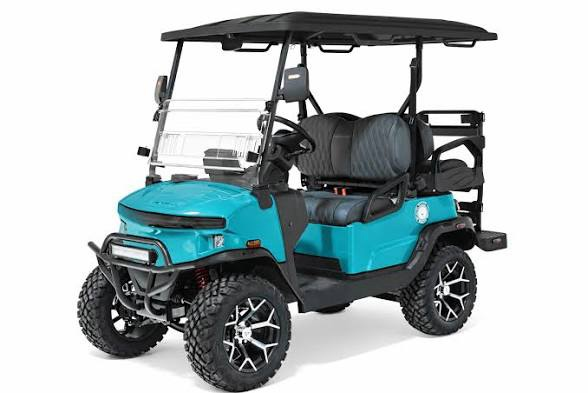
Before buying a golf cart, it is important to know how much physical space the vehicle needs. Golf cart dimensions affect everything from garage storage and trailer selection to driveway space, gate access, and passenger comfort. A cart that looks compact online might be harder to store once you account for its roof, mirrors, rear seat, tires, and other accessories.
Most standard golf carts are close to four feet wide, but their length changes considerably as seating capacity increases. A two-passenger model may measure around 7.5 to 8 feet long, while larger six-passenger models can stretch beyond 12 feet. Height also varies, especially when a cart has a lift kit or larger tires.
This guide breaks down golf cart length, golf cart width, and golf cart height so buyers can compare common configurations and plan for the right amount of space.
What Are the Standard Golf Cart Dimensions?
There is no single measurement that applies to every golf cart. Manufacturers build models with different chassis, seating layouts, suspension systems, roofs, and wheel packages.
As a general guide, standard two-passenger carts measure about 91 to 96 inches long, 47 to 49 inches wide, and around 70 to 72 inches high with the roof. Four-passenger models are usually longer, while six-passenger carts can extend well beyond 11 feet.
| Golf Cart Type | Typical Length | Typical Width | Typical Height |
| 2-passenger | 91–96 inches | 47–49 inches | 70–72 inches |
| 4-passenger | 106–128 inches | 46–52 inches | 71–76 inches |
| 6-passenger | 134–161 inches | 47–55 inches | 74–82 inches |
| Lifted 4- or 6-passenger | 108–149 inches | 49–53 inches | 80–87 inches |
These figures are useful for initial planning, but they should not replace the exact specifications for the model you plan to purchase. Accessories and modifications can change the final footprint.
Golf Cart Dimensions by Seating Capacity
Seating capacity is one of the biggest factors affecting a cart’s overall size. Adding another row of seats generally increases length much more than width.
2-Seater Golf Cart Dimensions
Two-passenger carts are the most compact common configuration. A typical model is around 91 to 96 inches long and roughly 47 to 49 inches wide. Height generally falls near 70 to 72 inches with the standard roof.
This compact footprint makes a two-seater practical for buyers with limited storage space. It also provides easier maneuverability around driveways, private roads, and other areas where space is limited.
A two-passenger cart is a sensible option when the vehicle will mainly carry one or two people. Buyers should still measure the exact model because windshield frames, mirrors, tires, and other additions affect the final measurements.
4-Seater Golf Cart Dimensions
Four-passenger carts vary more in length because manufacturers use different seating arrangements. A typical four-seater falls somewhere between about 106 and 128 inches long, while width usually remains close to 48 to 52 inches.
The extra length comes from the additional seating area. Some models have two forward-facing seats and others use a rear-facing bench configuration.
For families, four-passenger carts offer a useful balance between passenger capacity and storage requirements. However, buyers should measure their garage or parking area before choosing a model because a few inches of extra length can matter in a tight space.
6-Seater Golf Cart Dimensions
Six-passenger models require significantly more room. Typical six-seat carts range from roughly 134 to 161 inches in length, depending on the manufacturer and configuration. Width generally stays close to 47 to 55 inches.
The extra row or extended chassis makes these carts useful for larger families, hospitality properties, events, and other situations where transporting several passengers is important.
The main challenge is usually not width. It is length. A six-passenger cart may need considerably more garage depth, trailer length, and turning space than a two-seater.
How Wide Is a Golf Cart?
Golf cart width is usually more consistent than length. Many standard models measure approximately 47 to 49 inches across, although wider configurations and lifted carts can exceed 50 inches.
That makes width especially important when checking gates, garage doors, pathways, trailers, and narrow storage areas.
For example, a space that is only slightly wider than the cart itself leaves little room for mirrors or side clearance. A buyer should measure the narrowest opening the cart must pass through rather than measuring only the parking area.
Remember that the published vehicle width might not account for every aftermarket component. Wider tires, wheel spacers, fender flares, mirrors, or other modifications could increase the actual footprint.
How Tall Is a Golf Cart?
Golf cart height is generally around 70 to 75 inches on many standard models, although the exact measurement depends on the roof, suspension, tires, and other equipment.
Height becomes more important when the cart will be stored inside a garage, enclosed trailer, shed, or carport. A standard cart that fits comfortably under an opening might not fit after a lift kit and larger tires are installed.
Lifted golf carts frequently reach around 80 inches or more, depending on the configuration.
Before buying a lifted model, measure from the floor to the lowest overhead obstruction. Do not assume the garage door opening is the only measurement that matters. Door tracks, lighting fixtures, beams, and storage equipment can reduce usable clearance.
Why Golf Cart Length Matters Most for Larger Models?
When comparing golf cart dimensions, length usually changes the most as seating capacity increases.
A two-seater might fit comfortably in an area designed for a compact vehicle. A four-seater needs more depth, while a six-seater could require a much longer parking space.
This difference also matters when selecting a trailer. A trailer that works for a compact two-passenger cart might not provide enough deck length for an extended six-passenger model.
Buyers should measure the cart from its furthest front point to its furthest rear point. If a rear seat, cargo box, bumper, or other equipment extends beyond the main body, include it in the measurement.
How Golf Cart Modifications Change Dimensions?
A stock golf cart and a customized golf cart do not necessarily have the same footprint.
Lift kits raise the vehicle and often pair with larger tires. These changes increase overall height and could affect width. Rear seat kits increase the usable passenger area and could alter the vehicle’s total length.
Other accessories also deserve attention. Mirrors, brush guards, cargo boxes, fender flares, and extended roofs could add to the cart’s physical dimensions.
This is why buyers should use factory specifications as a starting point rather than treating them as the final measurement. If storage space is tight, measure the fully equipped cart.
Will a Golf Cart Fit in a Garage?
Many standard two-passenger carts fit into typical garage spaces, but the answer depends on the garage’s dimensions and the cart itself.
Length is important because the vehicle needs enough room to clear the garage door while leaving usable space around it. Width matters for door openings and side clearance. Height matters for the door and ceiling.
A good approach is to measure three things before buying:
- The garage’s interior length and width.
- The narrowest door or entrance opening.
- The lowest overhead obstruction.
Then compare those measurements with the cart’s exact dimensions. Leave practical clearance around the vehicle so you can open doors, walk around it, and access charging equipment.
Measuring a Golf Cart Before You Buy
If you are comparing models in a showroom or online, use the same measurement process for each cart.
Measure length from the furthest front point to the furthest rear point. Measure width at the widest part of the vehicle, including components that extend beyond the body. Measure height from the ground to the highest fixed point, normally the roof.
Also check the wheelbase, ground clearance, turning radius, and weight when these specifications matter to your intended use. Dimensions tell you whether a cart fits a physical space, while these additional specifications help determine how it behaves in that space.
For buyers comparing available vehicles, the golf cart selection from 808 Golf Carts provides a starting point for reviewing different configurations.
Golf Cart Dimensions and Trailer Selection
Trailer size should be based on the cart’s actual footprint rather than its passenger count alone.
A compact two-passenger model generally requires less deck length than an extended six-passenger model. Width also matters because the cart needs enough room to load safely while leaving space for proper tie-down positioning.
Check the trailer’s interior deck dimensions, ramp width, ramp angle, payload capacity, and tie-down points before purchasing or renting one.
Do not forget height if you plan to use an enclosed trailer. A lifted cart with a tall roof could require more interior clearance than a standard cart.
Choosing the Right Size for Your Needs
The right golf cart size depends on more than the number of people who will ride in it.
A two-seater is easier to store and maneuver. A four-seater provides additional passenger capacity without the footprint of many larger models. A six-seater offers substantially more seating but needs more room for storage and transportation.
Think about where the cart will be parked, how it will be transported, and how much clearance is available along the routes where it will operate.
If the vehicle will stay on a private property, also consider gate widths, pathways, storage buildings, and turning areas. A cart that fits the garage might still struggle with a narrow gate.
Frequently Asked Questions
1. What are the average golf cart dimensions?
2. How wide is a standard golf cart?
3. How tall is a golf cart with a roof?
4. Are 6-passenger golf carts much longer than 4-passenger models?
5. Do golf cart accessories change the dimensions?
Final Thoughts
Understanding golf cart dimensions before buying helps prevent problems with storage, transportation, gates, garages, and parking spaces. Length tends to increase significantly with passenger capacity, while width remains relatively consistent across many standard models. Height becomes particularly important when choosing a lifted cart or storing the vehicle under a low opening.
Before making a purchase, check the exact manufacturer’s specifications and measure the space where the cart will be stored. Account for accessories and modifications as well. A few minutes of measuring can prevent an expensive fit problem later.
For questions about golf cart sizes, models, or available options, contact 808 Golf Carts and discuss the dimensions that fit your needs.