

Buying a golf cart feels like a straightforward decision until you start thinking about how you’ll actually use it. That’s when the seating question becomes the most important one you’ll answer. Get it right and your cart fits your life perfectly the right number of people, the right amount of space, the right footprint for where you’ll park and drive it. Get it wrong and you’re either cramped every time you load up the family, or you’re driving a cart that’s twice the size you need for solo beach runs.
In Hawaii, where golf carts aren’t just for golf courses they’re how people cruise neighborhoods, explore resort grounds, get around private communities, and handle small-scale hauling on properties the seating decision carries real weight. The lifestyle use cases here are more diverse than anywhere on the mainland, and the right cart depends heavily on who’s riding, where you’re going, and how often.
This guide breaks down each seating size honestly what it’s good for, who it’s best suited to, and where its limitations show up so you can make the decision with clarity rather than guesswork.
2 Seater Golf Carts: The Solo and Couples Choice
A 2 seater golf cart is the most focused version of the product compact, maneuverable, and purpose-built for one or two people who want to move efficiently without any extra footprint.
The appeal is real. Two-seaters are the easiest to park, the most nimble in tight spaces, and typically the most affordable entry point into cart ownership. For a couple exploring a resort community, a solo commuter navigating a private neighborhood, or a golfer who primarily rides alone, the two-seater does everything needed without the bulk.
Where it falls short is equally clear. Add a passenger to a two-seater and you’re at capacity groceries, beach gear, or a third person all become a problem. For Hawaii families or anyone who regularly moves more than two people, the two-seater will feel limiting quickly. It’s the right cart for the right person, but that person has a fairly specific lifestyle profile.
Best for: couples, solo riders, private property use, resort guests wanting a personal runabout, golfers.
Limitations: no room for passengers beyond one, limited cargo flexibility, outgrown quickly if family size or use case expands.
4 Seater Golf Carts: The Most Versatile Size
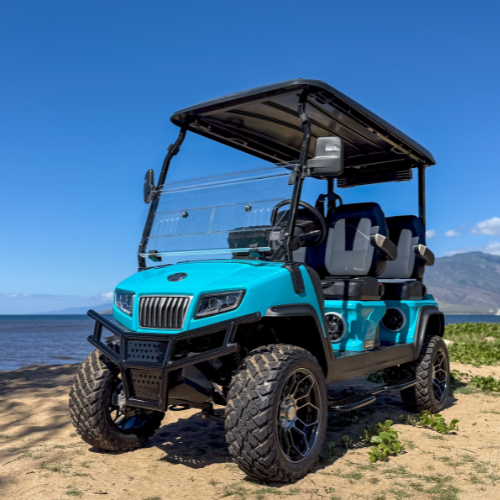
The 4 seater golf cart is where most buyers land, and for good reason it hits a sweet spot of capacity, footprint, and cost that works across the widest range of use cases. Two rows of seating handle a couple with kids, a small group of friends, or any configuration of four adults comfortably. The cart remains genuinely manageable in terms of size not so long that parking becomes a challenge, not so wide that narrow lanes or driveways create friction.
In Hawaii, four-seaters are popular with families who use their cart as a neighborhood vehicle school runs in gated communities, trips to the beach, evening cruises through resort areas. They’re also a strong choice for vacation rental property owners who want to offer guests a cart that can move a whole family without being oversized.
The four-seater is also a natural upgrade path for buyers who start thinking about a two-seater and then honestly account for how they actually travel. Most people who think “we’re just two people” are forgetting the kids who visit, the friends who come to stay, and the beach days where you want to bring more than one other person.
Best for: families with young children, couples who entertain guests, property owners, neighborhood commuters, small group resort use.
Limitations: a full family of five or six will outgrow it; cargo space is limited when all four seats are occupied.
6 Seater Golf Carts: Family-Sized and Resort-Ready
Step up to a 6 seater golf cart and the use case profile shifts meaningfully. Six seats typically configured as two front seats, a middle row, and a rear-facing back seat handle a full family, a small tour group, or a resort shuttle run without anyone feeling squeezed. This is the size where the cart stops being a personal vehicle and starts becoming genuine group transportation.
In Hawaii’s resort and luxury community context, six-seaters are extremely common. They’re used to move guests from accommodations to amenities, to transport families to the beach or golf course, and to serve as the primary vehicle on larger private properties where multiple people need to move together. For large families particularly those with kids old enough to fill the back row a six-seater is often the first size that genuinely works for everyone.
The footprint is larger than a four-seater, which matters for parking and navigation in tighter spaces. But on the streets and resort pathways of Hawaii generally wide, low-speed environments the extra length is rarely a practical problem. The street legal configurations available through 808 Golf Carts make six-seaters fully capable on public roads across the islands.
Best for: large families, vacation rental properties, small resorts and hotels, tour operators, community transportation.
Limitations: requires more parking space; higher cost than smaller sizes; more cart than needed for two-person households.
8 Seater Golf Carts: Maximum Capacity for Serious Applications
The 8 seater golf cart is a commercial-grade solution for applications where moving a lot of people efficiently is the primary requirement. Eight seats often in a forward-facing and rear-facing configuration across multiple rows is genuinely significant passenger capacity for a vehicle this size, and the use cases that justify it tend to be high-volume and recurring.
Resorts, hotels, large private estates, wedding venues, and commercial properties that need to move guests or staff regularly are the natural home for eight-seaters. In Hawaii specifically, luxury resorts and large vacation properties have strong demand for carts in this size range the ability to collect a family of six plus luggage from an arrival point, or to run a continuous shuttle between resort facilities, requires the capacity that only an eight-seater provides.
For private buyers, eight-seaters are less common but not unusual large families, multi-generational households, and property owners who frequently host groups sometimes find that the eight-seater is the only size that genuinely solves the problem. The cost is higher than smaller sizes, and the footprint is the largest in the range, but for the right application it’s the only cart that makes sense.
Best for: resorts, hotels, wedding venues, large commercial properties, estates, large extended families.
Limitations: significant upfront cost; larger footprint requires more parking space; too much cart for households that don’t genuinely need eight seats.
Side-by-Side Comparison: Quick Reference
Choosing between sizes becomes easier when the key variables are laid out together. Seating capacity is the obvious starting point, but footprint, cost, and ideal use case all matter equally in practice. Two-seaters are the most affordable and most compact, best for individuals and couples. Four-seaters represent the best all-around value for most private buyers, covering the majority of family and lifestyle use cases. Six-seaters step up for larger families and light commercial use where group capacity is regularly needed. Eight-seaters are the commercial solution for high-volume passenger movement at resorts, estates, and professional venues.
What cuts across all of these is the street legal question particularly relevant in Hawaii, where carts are increasingly used as genuine road vehicles rather than just golf course or property transport. All sizes available through 808 Golf Carts are offered in street legal configurations, meaning they meet the requirements to operate on public roads across the Hawaiian islands.
Hawaii-Specific Considerations
A few factors make the golf cart sizing decision slightly different in Hawaii than it would be on the mainland.
The islands’ terrain varies significantly between locations. Relatively flat coastal areas and resort communities are accessible to all cart sizes without issue. Hillier neighborhoods common in parts of Maui, the Big Island, and Oahu favor carts with stronger motor configurations, which is worth discussing with a dealer regardless of seating size. The question isn’t just how many seats, but whether the motor and battery system is appropriate for the terrain you’ll actually be driving.
Hawaii’s outdoor lifestyle also tends to mean more gear than mainland cart buyers account for beach equipment, surfboards in racks, coolers, grocery runs. A cart that fits the right number of people may not have the cargo flexibility you need if the back seat is always full. The six-seater with a rear-facing seat that can fold or be configured for cargo is a popular solution for families who want both passenger capacity and hauling flexibility.
Inter-island shipping offered free by 808 Golf Carts regardless of which island you’re on removes the logistical barrier that might otherwise limit your options based on local availability. You can access the full inventory from any island and have your cart delivered.
FAQs
Can I upgrade from a smaller to a larger cart later? Generally not golf carts are manufactured in specific size configurations and aren’t structurally converted between seating sizes. Choosing the right size upfront saves the cost of reselling and repurchasing later.
Are all seating sizes available as street legal carts in Hawaii? Yes. 808 Golf Carts offers street legal configurations across all seating sizes 2, 4, 6, and 8 seater options compliant with Hawaii’s low-speed vehicle requirements for public road use.
How does battery range vary by seating size? Larger carts generally draw more power, but the actual range depends more on motor configuration, terrain, and load than on seating size alone. All Evolution carts come with an 8-year battery warranty through 808 Golf Carts. Discuss expected range with our team based on your specific use case.
Is financing available for all cart sizes? Yes. 808 Golf Carts offers financing options for all seating sizes and credit profiles. Contact us to discuss what plan works for your situation.
What’s the price difference between a 4 and 6 seater? Pricing varies by configuration and model. The step up from a 4 to 6 seater is meaningful but often less than buyers expect. View current inventory for current pricing across all sizes.
Do larger carts require special licensing in Hawaii? Street legal golf carts in Hawaii operate under low-speed vehicle regulations. A standard driver’s license is required, but no special commercial license is needed for personal or private property use regardless of seating size. For commercial applications, confirm any additional requirements with your local DMV.