

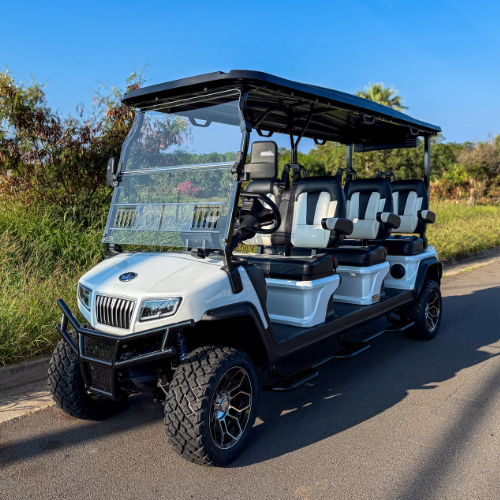
Golf carts are increasingly used across Hawaii for short-distance transportation in resorts, residential communities, and private properties. In certain situations, golf carts can also be made street-legal, provided they meet specific state and county regulations. Understanding these rules is essential for anyone researching golf carts for sale in Kauai or considering converting a cart for roadway use.
This guide explains how street-legal golf carts work in Hawaii, including DMV requirements, registration costs, safety standards, and how different seating configurations such as 2 seater golf carts and eight seater golf cart models fit into the regulatory framework.
What Is a Street-Legal Golf Cart in Hawaii?
In Hawaii, golf carts are not automatically permitted on public roads. To operate legally on certain streets, a golf cart must be classified and registered under the appropriate vehicle category, often as a Low-Speed Vehicle (LSV) or Neighborhood Electric Vehicle (NEV).
Street-legal status depends on:
- Vehicle speed capability
- Installed safety equipment
- Intended road usage
- Local county approval
Without meeting these criteria, golf carts are generally restricted to private property, golf courses, and designated community areas.
Hawaii DMV Classification for Golf Carts
The Hawaii Department of Transportation follows both state and federal definitions when classifying low-speed vehicles.
Low-Speed Vehicles (LSVs)
An LSV is defined as a four-wheeled motor vehicle that:
- Has a top speed between 20 and 25 mph
- Is designed for use on roads with speed limits of 35 mph or less
- Meets federal safety equipment standards
Golf carts that do not reach these speeds are typically not eligible for street use.
Neighborhood Electric Vehicles (NEVs)
NEVs are a subset of LSVs and are commonly electric powered. Many electric golf carts can be modified to meet NEV standards, provided they comply with safety and performance requirements.
Safety Equipment Required for Street-Legal Use
To qualify for street-legal operation, a golf cart must include specific safety features mandated by federal and Hawaii DMV regulations.
Required Equipment
Street-legal golf carts must have:
- Headlights and tail lights
- Brake lights
- Turn signals
- Reflectors
- Windshield
- Rearview mirrors
- Seat belts for all designated seating positions
- Vehicle Identification Number (VIN)
Without these features, registration for public road use is typically denied.
Additional Considerations
Some counties may require:
- Horns
- Parking brakes
- Tires rated for road use
It is recommended to verify county-specific requirements before initiating registration.
Registration Process for Street-Legal Golf Carts in Hawaii
Registering a golf cart for street use follows a process like registering other motor vehicles.
Step-by-Step Registration Overview
- Vehicle inspection to confirm compliance with safety standards
- VIN verification or assignment if the cart does not already have one
- Submission of registration documents to the local DMV
- Payment of applicable fees and taxes
- Issuance of license plate and registration certificate
Some golf carts may require modification before passing inspection.
Costs Associated With Registration and Compliance
Costs can vary depending on the cart, county, and required upgrades.
Typical Cost Categories
| Cost Type | Estimated Range |
| Safety equipment upgrades | Varies by model |
| VIN assignment | Nominal DMV fee |
| Registration and plates | Similar to LSV fees |
| Annual renewal | Standard vehicle renewal |
These costs are separate from the purchase price of the cart itself.
Road Usage Restrictions in Hawaii
Even when registered, street-legal golf carts are not permitted on all roads.
Permitted Road Types
Street-legal golf carts may typically operate on:
- Roads with posted speed limits of 35 mph or less
- Residential streets
- Designated community roadways
Restricted Areas
They are generally prohibited on:
- Highways
- Roads with higher speed limits
- Areas without appropriate signage or approval
Local ordinances may further limit where golf carts can be used.
Seating Capacity and Legal Considerations
Seating capacity plays a role in safety compliance and vehicle classification.
2 Seater Golf Carts
2 seater golf carts are the most straightforward to convert for street-legal use. Their lighter weight and smaller size often make it easier to meet speed and safety requirements.
Common use cases include:
- Short residential travel
- Individual or couple transportation
- Small property mobility
Seat belts and designated seating positions are required for both occupants.
Four and Six Seater Carts
Mid-size carts can be registered if they meet equipment and safety standards. Additional seating requires:
- Proper seat belt installation
- Structural support for passenger seating
- Compliance with weight limits
These carts are often used in planned communities or resort-adjacent areas.
Eight Seater Golf Cart Models
An eight seater golf cart presents additional regulatory considerations. Due to size and passenger capacity, these carts are more commonly used on private roads rather than public streets.
Key challenges include:
- Increased weight
- Longer stopping distances
- Limited maneuverability
Some eight-seater models may not qualify for street-legal status depending on specifications and local approval.
Golf Carts for Sale in Kauai and Street-Legal Use
When researching golf carts for sale in Kauai, buyers should determine whether the cart is intended for private use or potential street operation.
Questions to Ask Before Purchase
- Can the cart reach LSV-qualified speeds?
- Does it support required safety equipment?
- Is the frame suitable for additional modifications?
- Are parts and service readily available locally?
Local providers such as 808 Golf Carts often work with models commonly used across the island, which can simplify long-term compliance and maintenance planning.
County-Level Differences in Hawaii
Hawaii consists of multiple counties, and each may apply regulations slightly differently.
County Authority
Counties may:
- Restrict specific roads
- Set additional safety requirements
- Define local enforcement practices
Checking county transportation or public works departments is essential before registering or operating a street-legal golf cart.
Environmental and Practical Considerations
Electric golf carts are commonly favored due to their lower noise levels and absence of tailpipe emissions. When used appropriately, they align with Hawaii’s environmental priorities.
However, battery disposal, charging infrastructure, and electricity sourcing should be considered as part of responsible ownership.
Insurance and Liability Requirements
Street-legal golf carts typically require insurance coverage similar to other registered vehicles.
Common Insurance Requirements
- Liability coverage
- Personal injury protection
- Property damage coverage
Insurance requirements may vary by provider and vehicle classification.
Maintenance Responsibilities for Street-Legal Carts
Once registered, golf carts used on public roads are subject to ongoing maintenance obligations.
Key Maintenance Areas
- Brake system inspections
- Lighting and signal functionality
- Tire condition
- Battery or engine performance
Failure to maintain required safety features can result in citations or loss of registration.
Frequently Asked Questions
Are golf carts automatically street-legal in Hawaii?
No. Golf carts must meet LSV or NEV requirements and be registered with the DMV before operating on public roads.
Can I make an existing golf cart street-legal?
In some cases, yes. Modifications may be required to meet safety and speed standards.
Is an eight seater golf cart allowed on public roads?
Not always. Due to size and weight, many eight-seater models are limited to private or designated roadways.
Do 2 seater golf carts qualify more easily for registration?
Generally, yes. Smaller carts are often easier to modify and inspect for compliance.
Conclusion
Street-legal golf carts in Hawaii offer a practical transportation option when properly classified, equipped, and registered. Understanding DMV rules, seating limitations, and county-level restrictions helps owners make informed decisions and remain compliant with local regulations.
Whether evaluating 2 seater golf carts, larger passenger models like an eight seater golf cart, or researching golf carts for sale in Kauai, careful planning ensures safe and lawful operation across the islands.